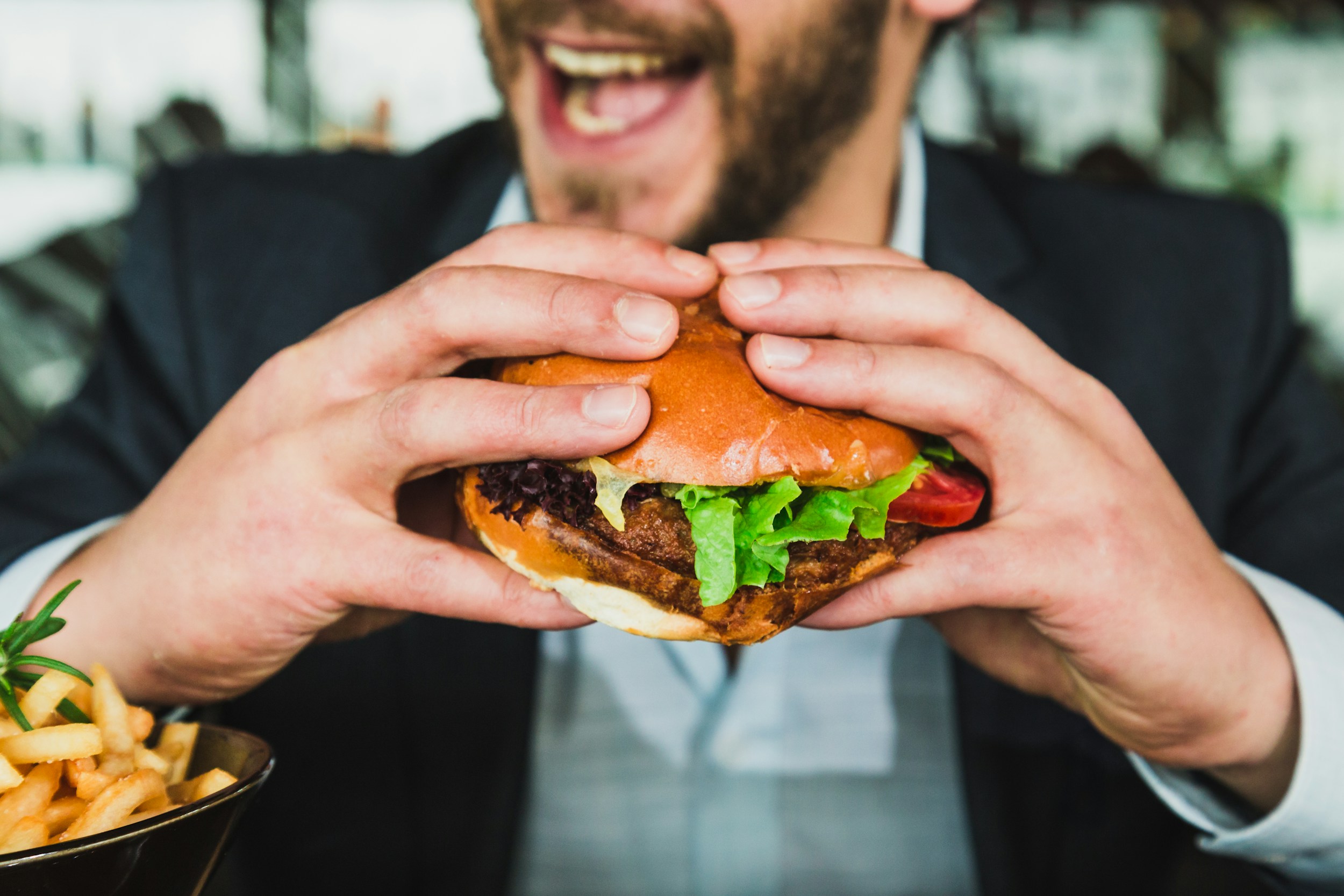
You've been there. Lunch break is 20 minutes, you're starving, and before you know it your meal is gone and you feel like you swallowed a brick. The fullness hits hard and late, the bloating kicks in, and your afternoon becomes a battle between productivity and your own stomach.
Most people brush this off as normal. It isn't. Eating too fast is one of the most underrated causes of chronic digestive problems — and the damage goes much deeper than feeling uncomfortably full. It disrupts your digestive enzymes, confuses the hormones that control hunger, and can even shift the balance of bacteria in your gut over time.
The good news? It's one of the most fixable gut health habits you have. But first, you need to understand what's actually going wrong.
Digestion Starts Before You Swallow
Here's something most people don't fully appreciate: digestion is supposed to begin in your brain, not your stomach.
When you see, smell, or even just think about food, your body begins preparing. Saliva starts flowing — and saliva isn't just there to make food easier to swallow. It contains salivary amylase, an enzyme that begins breaking down carbohydrates before the food even reaches your stomach. It also contains lingual lipase, which starts working on fats.
This is called the cephalic phase of digestion, and it primes the entire system. Your stomach starts releasing acid. Your pancreas gets ready to secrete digestive enzymes. Your small intestine prepares to receive and absorb nutrients.
When you eat fast, you shortcut this phase almost entirely. You chew less, produce less saliva, and send large, poorly prepared food particles hurtling toward a digestive system that hasn't had time to get ready.
The rule of 32: Traditional Ayurvedic medicine recommends chewing each bite 32 times. Modern research doesn't land on an exact number, but studies consistently show that chewing food more thoroughly improves nutrient absorption and reduces digestive discomfort. Somewhere between 20 and 30 chews per bite is a reasonable target for most foods.
What Happens When You Eat Too Fast
Once poorly chewed food reaches your stomach, a cascade of problems begins.
Your stomach has to work overtime
The stomach's job is to churn food into a liquid paste called chyme before passing it into the small intestine. Normally, this takes around two to four hours depending on what you ate. When food arrives in large chunks — because you chewed too little — the stomach has to work much harder and much longer to break it down.
This extended churning produces more gas, increases the likelihood of acid reflux (because the stomach stays fuller for longer), and can cause that heavy, uncomfortable “brick in my stomach” sensation that lingers for hours.
Digestive enzymes get overwhelmed
Your pancreas releases digestive enzymes — including proteases for protein, lipases for fat, and amylases for carbohydrates — in response to the food arriving in your small intestine. These enzymes work best when food arrives in small, steady amounts that have already been partly broken down.
When a large, poorly chewed bolus of food arrives rapidly, the enzymes can't keep up. Undigested or partially digested food then passes further into the intestine, where gut bacteria ferment it. That fermentation produces gas — which means bloating, cramping, and flatulence.
You swallow more air
Rapid eating almost always involves swallowing more air. This is called aerophagia, and it's a direct cause of bloating and belching. Every forkful you rush down comes with a gulp of air that has to go somewhere. Your digestive tract is not a comfortable place for excess air.
The Hormone Problem
This is where the consequences of eating fast become truly systemic — affecting not just your gut, but your weight, blood sugar, and long-term relationship with food.
Your body uses a sophisticated hormonal feedback system to tell you when you're full. Two of the key players are leptin and ghrelin. Ghrelin rises when you're hungry and falls when you're satisfied. Leptin signals fullness from fat cells. But there's a delay built into the system.
It takes approximately 15 to 20 minutes after eating for fullness signals to travel from your gut to your brain. This lag exists because satiety hormones — including cholecystokinin (CCK), peptide YY (PYY), and GLP-1 — are released as food moves through the digestive tract. They need time to accumulate and reach the brain in sufficient amounts.
When you eat an entire meal in eight minutes, you bypass this feedback loop almost completely. Your brain hasn't received the “we're full” signal yet, so you keep eating. You likely overshoot your actual caloric need by the time the signal finally arrives — and then you feel stuffed.
The research backs this up: A 2008 study published in the Journal of the American Dietetic Association found that people who ate slowly consumed significantly fewer calories and reported higher levels of satiety compared to fast eaters, even when given the same food. The slow-eating group also drank more water naturally, which further aided digestion.
Over time, consistently eating too fast can desensitise your hunger and satiety cues, making it harder to recognise when you're actually hungry or genuinely full. This is one of the mechanisms linking fast eating with weight gain, independent of what you're eating.
How Speed Eating Affects Your Gut Bacteria
Your gut microbiome is sensitive to what arrives in the large intestine — both in terms of content and in what state it arrives.
When undigested food particles reach the colon because they weren't broken down properly earlier in the process, the microbial community has to deal with a larger fermentation load than usual. This can selectively feed certain bacteria over others. In particular, gas-producing bacteria thrive on fermentable carbohydrates and undigested proteins — and if they're consistently receiving more fuel than usual, their populations can grow disproportionately.
This bacterial imbalance — sometimes called dysbiosis — has been linked to chronic bloating, irregular bowel movements, increased intestinal permeability (sometimes called “leaky gut”), and even systemic inflammation.
There's also the issue of bile. When you eat quickly, the gallbladder doesn't always receive adequate signalling to release enough bile for fat digestion. Poorly digested fat in the colon is a known irritant for the gut lining and can fuel inflammation over time.
Signs You're Eating Too Fast
It's surprisingly easy to eat quickly without realising it — especially if you grew up in a household where meals were rushed, or if you've developed the habit of eating while distracted. Here are the telltale signs:
- You regularly feel bloated within 30 minutes of eating — especially if it happens with a wide range of foods, not just specific triggers
- You often feel uncomfortably full shortly after finishing — the fullness hits like a wave rather than building gradually
- You finish meals significantly faster than others at the table — if your plate is empty while others are halfway through, that's a sign
- You experience frequent belching after meals — a classic sign of aerophagia from rapid eating
- You eat while distracted — at your desk, watching TV, scrolling your phone — which almost always speeds up eating without you noticing
- You rarely taste your food consciously — if you struggle to describe what your meal actually tasted like, you weren't present while eating
- You have acid reflux or heartburn regularly — particularly after larger meals eaten quickly
How to Slow Down and Actually Enjoy Eating
Knowing you eat too fast and actually changing the habit are very different things. Fast eating is often deeply ingrained — shaped by childhood, work culture, stress, and the unconscious rituals built around food. Here are strategies that actually work:
Put your fork down between bites
This sounds almost comically simple, but it's one of the most effective interventions. Place your utensil on the plate after each forkful. Pick it up only after you've fully chewed and swallowed. It forces a pause that your brain eventually internalises.
Eat without screens
Eating while watching TV, scrolling social media, or working at your computer is one of the fastest ways to eat without awareness. Distraction not only speeds up eating — it also impairs the brain's ability to register satiety signals. Studies on mindless eating consistently show that distracted eating leads to higher calorie intake and lower satisfaction. Try one meal a day with no screens for two weeks and notice the difference.
Start with a few deep breaths
Before you eat, take three slow, deep breaths. This activates your parasympathetic nervous system — the “rest and digest” mode — and genuinely primes your digestive system to function better. It also helps transition your brain from whatever you were doing before eating to actually being present for the meal.
Use smaller utensils or smaller plates
Smaller forks and spoons naturally result in smaller bites. Smaller plates reduce the visual cue to keep eating. Neither of these changes requires willpower — they're environmental nudges that shift behaviour automatically.
Chew more deliberately
You don't need to count to 32 every bite (that gets tedious fast). Instead, aim to chew until your food is paste-like before swallowing. For most foods, this is significantly more chewing than you're probably doing. Pay attention to texture — it tells you when food is ready to move on.
Drink water between bites, not during
Sipping water between bites naturally slows eating pace. Avoid gulping large amounts of water with food, as this can dilute digestive enzymes and stomach acid if done excessively — but small sips throughout a meal are fine and helpful.
Mindful eating vs. slow eating: These are related but not the same. Mindful eating is about awareness — noticing flavours, textures, hunger cues, and fullness. Slow eating is about pace. Ideally you want both, but if you're starting out, focusing purely on pace first is simpler and still delivers most of the digestive benefits.
The 20-Minute Rule
Here's a practical framework to anchor everything: aim to spend at least 20 minutes eating any main meal. This isn't arbitrary. It aligns with the approximately 15-to-20-minute delay in fullness signalling, meaning by the time you finish eating, your brain is actually receiving satiety feedback in real time rather than after the fact.
You don't need a timer, though one can help initially. A rough guide:
- Breakfast: 15 to 20 minutes minimum
- Lunch: 20 minutes minimum
- Dinner: 20 to 30 minutes — ideally longer if you're eating socially
If you're eating a full meal in under 10 minutes, you're likely not chewing adequately, you're probably swallowing air, and your gut is definitely feeling the consequences.
For those who have genuinely limited lunch breaks or busy mornings, even adding five minutes to your current eating duration is meaningful. You don't have to overhaul everything at once — small, consistent changes in pace produce real digestive improvements over time.
The Bottom Line
Eating too fast is one of those habits that seems harmless until you understand the full chain of events it triggers. Skipped cephalic digestion, overwhelmed enzymes, swallowed air, bypassed satiety hormones, and an overworked gut microbiome — all from rushing a meal.
The encouraging truth is that slowing down is free, requires no supplements or special foods, and produces results quickly. Many people notice a significant reduction in bloating, reflux, and post-meal discomfort within days of genuinely eating more slowly.
Your digestive system is extraordinarily capable when given the right conditions. Giving it time is perhaps the simplest condition of all.